Reflecting on BTC 100k

I first came across Bitcoin in 2011 when it was worth around $10 or so.

Back then, I was an overly philosophical 21-year-old, just about to finish college, and deeply obsessed with libertarian or more accurately, classical liberal thinking. I had serious ideological objections to the level of control governments exercised over our bodies, particularly when it came to the consumption of certain substances, and it was along these lines of inquiry that I first read about a marketplace on the dark web called Silk Road.

Silk Road, before being shut down by the FBI in 2013, used Bitcoin as a way to facilitate transactions in illegal drugs (and much worse). Being libertarian-minded but also highly risk averse, I never transacted on Silk Road, and never purchased (or sold short) Bitcoin. I did, however, follow closely the narrative of the original true believers of Bitcoin, its journey into the mainstream, and of course the spectacular boom-and-bust-and-boom cycles that increased its price 10,000-fold in the intervening 13 years.

What strikes me today looking back at the 13-year journey is the radically shifting narrative around what Bitcoin is good for.

In the early years, there was a lot of talk about the functions of currency, and there was a belief that Bitcoin’s adoption as currency would start from its use as a medium of exchange. Silk Road was an early example, but this narrative started to run into difficulties as it became apparent that Bitcoin at scale was orders of magnitude less efficient than existing, centralised payment technologies, such as credit cards. Bitcoin still appeared to have advantages in black/grey markets by side-stepping pesky regulations like KYC/AML, or sanctions and anti-terrorism financing, but the enthusiasm around Bitcoin as a medium of exchange dropped off markedly from the mid/late 2010s.

Many early believers in Bitcoin were, similarly to 21-year-old me, sceptical of governments and interested in libertarian ideology. They thought it was important that Bitcoin was designed as a “trustless”, decentralized system that was immune to government control. Coupled with the supply of Bitcoin forever capped at 21 million, Bitcoin could be seen as a store of value, a way of stashing away funds outside the reach of oppressive regimes.

Trustless Bitcoin, while ideologically pleasing to the true libertarian, was impractical. Firstly, one needed to exchange fiat currency to obtain Bitcoin through an “on-ramp” which was vulnerable to government monitoring. There were some Craigslist-type sites where the diehard libertarian could arrange a rendezvous in a dark alley to anonymously and untraceably exchange physical cash for the private keys to some Bitcoin, but this was completely unscalable in addition to the obvious risks of scams and abuse.

After some painful lessons from the collapse or hacking of some exchanges, such as Mt Gox in 2014, the libertarian Bitcoiner advocated for “self custody”, i.e. storing your coins by memorizing your private keys (or, as a second-best alternative, writing them down on a piece of paper that you hide away). Still, Bitcoin fortunes were easy-come-easy-go, and forgetting or losing your private keys meant that your Bitcoin was gone forever (as James Howells, the man suing for £500m the British municipality that would not let him dig up the landfill where the hard drive holding his private keys is believed to be buried, could tell you).

Libertarianism has ultimately always been a fringe ideology. It is forever doomed to appeal to philosophical weirdos but is too impractical and counterintuitive to win mainstream adoption. It is no accident, therefore, that Bitcoin’s spectacular conquest of the masses was enabled by shedding its libertarian roots.

To go big, Bitcoin had to become accessible. A new generation of centralized exchanges sprang up that saw Bitcoin first and foremost as a business and discarded all the trustless nonsense. The vast majority of Bitcoin today is bought by making a bank transfer to a business that has a copy of your passport, and your Bitcoin is never more than a court order away from being under the government’s control. Bitcoin ETFs, managed by the stalwarts of mainstream institutional finance, now allow enthusiasts to gain price exposure to Bitcoin while disregarding all of the founding principles of Bitcoin.

Most ironically, the wildest frenzy today about Bitcoin potentially hitting $200k, $1 million, or $10 million per coin, is driven by narratives of the U.S. government – the perennial libertarian bogeyman – creating a “Strategic Bitcoin Reserve”. The early believers thought that Bitcoin was valuable because it could exist outside government control – the wildest cheerleaders today are rooting for the government to take over. It is crazy, but crazier things have happened in politics.

The arguments for Bitcoin today feel unsatisfying in comparison to the early days.

I am told almost every day that Bitcoin is “digital gold”, a way of protecting one’s net worth against hyperinflation due to fiat money-printing. But there are many other assets that are better suited to hedge inflation (inflation-linked bonds, farmland, housing, commodities, actual gold), and you can access all of these easily through exchange-traded products the same way you hold a Bitcoin ETF.

I also hear that Bitcoin is a bet to preserve wealth in a post-apocalyptic world where society breaks down. Even ignoring that Bitcoin is entirely reliant on the continued functioning of the internet and computing, I would much rather stockpile canned food, a water purifier, guns, and ammunition.

I do believe Bitcoin has value today. I think Ken Griffin (founder of Citadel and probably the most important person in finance today) put it best – Bitcoin has captured the zeitgeist. It has a spectacular 15-year price chart, it has minted stellar fortunes for so many, and captivated the public. Bitcoin is valuable in the same way as the Kardashian name is valuable.

Will it last forever? I think not, but very few things do. You can probably still make money with it.

Reflecting on BTC 100k

The Trump Honeymoon

I immensely dislike both Donald Trump as a person and Trumpism as a political movement for a long list of fairly consensus reasons, which would be way too boring to enumerate here. I am, therefore, naturally sad that Americans – whom in my personal interactions and travels have always found to be a friendly, open-minded, and fundamentally decent group of people – have again chosen such an off-putting leader.

The election result, while disappointing, was not particularly surprising. The Harris candidacy was burdened by at least three major issues from the outgoing administration, each of which would have been sufficient on their own to lose an election: losing control of the Southern border for a while, being too late to notice inflation, and playing an impotent witness to America’s declining power abroad as war flares up all over the globe.

Once you combine the baggage of the past 4 years with the awkward, late switchover from the visibly unwell Biden to Harris – an ineffectual communicator who was the first to crash out of the 2020 Democratic primaries – the hurdle was too high. Harris did her best in the campaign and I think she would have made a good president, but that all is now irrelevant.

The Trump honeymoon will last 2 months before he is inaugurated. He does not yet have to face the messy reality of being in charge, so now is a time for imaginations to run wild. Americans, in comparison to the rest of us, are optimists, so – at least to this cynical European – the high expectations for the next 4 years seem frankly silly.

I would propose that in 2024, Donald Trump is a known quantity. There was more uncertainty when he burst onto the political scene in 2015, but since then, the world got to know him well through his 4 years in power and 4 years out of it. There is perhaps some legitimate expectation that he realized he needs to do some things differently after his first term, but 78-year-olds generally do not change massively.

Trump’s overwhelmingly defining character trait is that he is a narcissists with a fragile ego. Everything he does flows from this attribute. His number one desire is to respected by his rivals and loved by the masses. In every speech he makes, no matter the occasion or the intended topic, he reverts to rambling on about how he is the best, the smartest, the richest, the most successful, and so on.

Trump, by trade, is an entertainer. He is funny in his own, distasteful, way. He is great at improvising in off-the-cuff moments, and he is energized by the public’s attention. He dazzles the audience because he loves his job and never wants to stop talking.

Conversely, Trump is not a doer. Nothing really matters to him besides his own public imagine, and he has no deep convictions or principles. Trump loves talking about bombastic policy proposals (like mass deportations, ending the war in Ukraine in 24 hours, or radically cutting government spending), because it gets him attention, but he has zero interest in actually implementing them.

Doing things is really hard, even when you’re the President. It takes relentless dedication, work ethic, and the ability to lead, inspire, and build coalitions to set an agenda, stick to it, and deliver results. Trump has none of that. He is so in love with himself that he cannot hold a working team together as he will be quickly frustrated by his team’s perceived inferiority in comparison to his own excellence. Throughout his first term, Trump would often publicly admonish his own appointees, sometimes within months of making the appointment.

Forget his specific policies for a moment – how could a leader with Trump’s character be effective? Trump fell out with his secretary of state (Rex Tillerson), two defence secretaries (Jim Mattis and Mark Esper), national security adviser (John Bolton), chief of staff (John Kelly), attorney general (Bill Barr), communications director (Anthony Scaramucci), and vice president (Mike Pence), just to name a few.

The people who got anything done in the first Trump administration were the men (sorry, it is almost always the men) who did have a deep personal conviction on a specific issue, and were ruthlessly strategic to stroke Trump’s galactic ego sufficiently to gain power. This is why the most consequential outcome of the first Trump administration was the Trump tax cuts (a long-running agenda of the mainstream Republican elite, but not a particular priority for the Donald himself), and Trump’s own signature promises during his 2016 campaign (such as the border wall, locking up Hillary Clinton, or repealing and replacing Obamacare) fizzled out without ever coming even close to fruition.

For now, however, people can dream.

The Trump Honeymoon

Why vaccine passports in Britain are a terrible idea

1) The problem vaccine passports are trying to solve does not really exist.

There is a widespread belief that that Britain will not be able to achieve herd immunity to Covid due to a substantial proportion of the population refusing vaccines. Supporters of vaccine passports believe that banning the unvaccinated from nightclubs, pubs, large events and other places will compel them to get vaccinated.

The data simply does not support this belief. 88% of adults have already taken at least one dose of the vaccine. In the young adult (18-29) age group, which is often singled out for alleged anti-vax sentiments, 66% have had at least one jab, which is a good result considering that they only became fully eligible for vaccination about a month and a half ago. This number is certain to rise in the coming months as only a vanishingly small fraction of society will refuse to be vaccinated on principle: 7 – 10% of young adults and 4% of the general adult population was found to be vaccine hesitant.

2) Vaccine passports are an unnecessarily drastic step before softer measures are exhausted

If there is a real fear that the vaccine take-up in young adults will stall at 66%, why not try the carrot before the stick? It is natural that after 18 months of emergency measures the public would rather chop off some heads than try reasoning with people, but it would be far cheaper and easier to offer a £100 payment to each fully vaccinated young adult (think of it as a symbolic payment in recognition of the disproportionate sacrifices young adults were asked to make during the pandemic).

3) Vaccine passports ignore natural immunity due to prior infection

There is now a good body of evidence showing that recovery from prior infection offers strong protection against re-infection. Freaking out about 34% of young adults being unvaccinated ignores the fact that a substantial portion of them will already have protection (90% of 30-year-olds were found to already have antibodies against Covid). If there truly is a concern about unvaccinated young people, surely the problem will solve itself quickly as they get infected by and recover from Covid. We know that the Covid only presents a small risk to healthy young adults, and by now everyone choosing to remain unvaccinated is willingly taking that risk.

4) The fully vaccinated can still spread Covid

The argument that the unvaccinated pose a threat to the vaccinated does not stack up. While vaccines offer strong protection against serious illness or death from Covid, the most recent data emerging from highly vaccinated countries (such as Israel or Gibraltar) shows that vaccines are less effective at preventing infection.

5) The risk of eroding civil liberties is too great

Once pubs and other venues are forced to implement a mechanism for checking everyone’s vaccine passports on entry, it will become trivially easy to expand the system to advance other social objectives, and transform Britain into a “papers, please” society. The slope seems particularly slippery in this instance: once vaccine passports are normalised, who could possibly say no to linking the vaccine database to also check for say police arrest warrants on entry? What about banning criminals and other social undesirables? Once it’s normal for pubs, why not roll it out to all public venues?

So why do people still want vaccine passports?

This blogger continues to hang on to the sometimes unpopular belief that society’s response to the pandemic is best understood through the lens of politics and mass psychology, rather than science. The answer to why (and when) various measures were implemented lies not in epidemiological models, but in the fears and motivations of the public and their leaders.

The largely vaccinated British public is ready to go back to pubs, but is still very much uncomfortable with Covid remaining in circulation in society (even though the government now says Covid will circulate forever). This drives public demand for highly visible, symbolic measures so that we can pretend we are being kept safe. Cracking down hard on the anti-vax nut jobs is a great way for the government to signal it is still tough on Covid (and who does not love tough leadership in times of crisis?).

The fear that a small group of people is undermining some social goal, and therefore the government must persecute them aggressively for the benefit of wider society is perhaps the longest-running theme in the history of human society. As much as we like to believe that 2020/21 is the pinnacle of scientific progress and rational thought, in many ways we are still the same humans that we have always been.

Why vaccine passports in Britain are a terrible idea

Lockdowns are politics, not science

Lockdowns are implemented on the basis of subjective value judgements about society’s priorities, not scientific proof. You can disagree with lockdowns without being anti-science. 

 
There is very little evidence to show that stricter lockdowns are worth it. The countries that locked down quickly had favourable outcomes in the first wave. After Covid spread widely in a country, there has been no correlation between stricter measures and mortality. There is no data to show that the more sadistic measures (such as restrictions on outdoors exercise or outdoors mask wearing mandates) have yielded any benefit. 
 
Despite the varying levels of lockdown, the second wave has followed largely the same curve across Europe. All European countries got Covid mostly under control by August, including Sweden with its far more relaxed approach, only to be hit by the second wave a couple months later. The passing of the first wave probably has a lot more to do with the normal seasonality of coronaviruses rather than the supposed success of the first lockdown. Similarly, the winter resurgence has not been prevented by any European country, no matter how strict or loose the restrictions were.
 
Contrary to the tired cultural stereotypes, the East Asian countries that got Covid under control owe their success to acting quickly rather than brutal lockdowns. Not even China had much of a lockdown outside of Wuhan and the surrounding Hubei province. The only place in the world where a strict, long term lockdown has actually led to the eradication of Covid is Victoria, Australia. This strategy failed in every other country that tried it. 
 
Public morale and compliance with the restrictions is low. Poor compliance is used to explain away the very predictable failure of the November lockdown. Moralising is not productive. Policy makers need to take into account that they are designing rules for human society rather than perfectly compliant robots. If a plan fails because it did not take into account that humans would behave like humans, it was not a great plan to begin with.
 
Lockdowns are popular in theory, as long as they apply mostly to other people. Most of the public support lockdown in general but fail to comply even with the most basic anti-pandemic principles. Shockingly, only about 20% of people actually subject themselves to a full quarantine when they experience symptoms of Covid. The public’s expressed and revealed preferences on Covid are wildly different. This, of course, is incredibly hypocritical but also entirely human.
 
The political impetus to lock down is great. The early few months to 2021 will be grim no matter what. The public expect the government to take decisive action and we are in no mood to argue whether the decisive action being taken is actually helping. 
 
It is deeply embedded in human psychology that sacrifice will bring results. It’s generally a useful belief to have as it inspires hard work and delayed gratification. The public wants to believe that by sacrificing so much we will achieve something, even if it’s as scientific as the Aztecs’ human offerings to keep the sun coming up in the morning. 
 
Lockdown is best understood as a religious proposal. The foundation of religious belief is that sin must be punished with suffering, and that through suffering, better days may come. Society has sinned (has anyone actually complied with every single covid rule?) so we lock down as penitence and when the next Covid trough comes in the natural ebb and flow of viruses, we’ll all praise the grace of the gods of lockdown. 

Lockdowns are politics, not science

The second lockdown is a terrible mistake

The first lockdown failed miserably. Why are we not learning?

The first lockdown – originally announced in late March as a 3-week measure to “flatten the curve” – has inflicted a terrible toll on all of society. I am not talking about money (does anyone even care what the budget deficit is these days?) – the restrictions have left long-lasting damage on every aspect of our lives.

We have sacrificed children’s education. A generation of 18-year-olds have been royally screwed over by the inexcusable failure to organise A-levels. Cancer screenings have been cancelled and mental health ignored. Arts, sports, leisure, travel – activities that make life worth living – have been decimated.

Public opinion has largely supported the first lockdown. Some (including myself) may have questioned whether there really was a viable plan, but society has listened to experts and made every effort to go along with the government’s plan.

It is now clear that the first lockdown was a miserable failure. Despite all of our efforts, we are no better off than we were at the start of pandemic, back in March. Society has never made greater sacrifices in peacetime, yet the results are precisely zero. It is nonsensical to talk about lives saved, when all we got was a deferment for a few months. The lockdown saved lives only in the sense that a delayed mortgage repayment saves you money.

When pharmaceutical companies develop a new drug, society requires a rigorous approval process to ensure that the drug is effective and that any side effects are substantially outweighed by its benefits. With the lockdown, no one ever calculated how the benefits of this never-tried-before non-pharmaceutical intervention stack up against its terrifying costs.

Incredibly, the government’s plan for November is exactly the same plan that got us nowhere just a few months ago. It is laughable to think that a 4-week lockdown will make any long-term, strategic impact on the epidemiological situation. As schools will remain open, there is no chance that the second lockdown will make the virus any less endemic. The measures are a pathetic non-solution that achieve nothing of lasting value, and are largely intended only to counteract the political damage for the government from the inevitable death toll.

So what can be done?

The most valuable insight from Sweden’s state epidemiologist, Anders Tegnell, was his comments about sustainability

“At the outset, we talked very much about sustainability, and I think that’s something we managed to keep to. And also be a bit resistant to quick fixes, to realise that this is not going to be easy, it is not going to be a short-term kind of thing, it’s not going to be fixed by one kind of measure. We see a disease that we’re going to have to handle for a long time into the future and we need to build up systems for doing that,”

We need to work on the assumption that Covid is here to stay. It is far, far too widespread across all of Europe to eradicate with lockdowns. Every single country in Europe is experiencing a second wave, no matter how strict and long the first lockdown was. Test & trace systems made no difference (Baroness Harding wasted an incredible amount of money on a useless system, but in all fairness, she was given an impossible task). Cases are surging even in Germany, the land of supposedly good Covid governance. 

The vaccine, which some think is almost ready, remains the Holy Grail for lockdown proponents. I sincerely hope they are right, but I worry that getting to a solution that is safe 99.99% of the time (which is the standard we would require to inject billions of people) will take more than a few months of testing. We still cannot even rule out the possibility that a safe and effective vaccine will never be found.

Sustainability needs to be the key word in our Covid response. We need a realistic plan that draws the conclusions from the failure of the first lockdown, and does not rely on wishful thinking about vaccines or “moonshot” schemes. The government needs to have an adult conversation with society about co-existing with Covid in the long term. Hiding away from the problem until 2 December will not help at all.

The second lockdown is a terrible mistake

Some questions about Chinese Covid-19 data

China massively understated the spread of coronavirus across its territory. This may have led to Western decision-makers acting too late.


  • China’s official coronavirus data suggests that the country was incredibly successful in not letting the virus spread beyond its place of origin: Wuhan and the neighbouring Hubei province.
  • As of today, China confirmed a total of 14,402 cases of Covid-19 outside Hubei with 120 deaths(1).
  • A basic analysis of these figures is sufficient to conclude that the figures are wildly understated. The difference against the lowest reasonable estimate of the true spread of coronavirus across China excl. Hubei is so great that this cannot be simply due to difficulties in testing and data management that other countries also experience.
  • On the face of it, there appears to have been a systemic effort to understate the spread of the epidemic across Chinese territory. This may have lulled Western decision-makers into a false sense of security as it appeared that the virus was largely confined to a single province in central China with only limited spread elsewhere.
  • Once the smoke settles, we will need to seriously consider to what extent China is responsible for the slow Western response to the onset of the crisis in late January and February.
  • We should be very sceptical of claims that China’s management of the virus provides the roadmap out of the crisis, given the dubious quality of data coming out of the country.

Putting the official Chinese coronavirus data in context

  • Iceland has arguably done the best job in the West in containing the virus. It has tested about 10% of its population, by far the largest share in the world. It is fair to assume that Iceland’s coronavirus data is the most reliable currently.
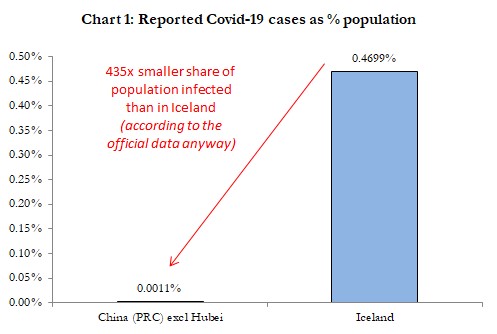
    • As of today, Iceland has recorded 1,711 cases of Covid-19 with 8 deaths(2). The recorded cases represent about 0.47% of the Icelandic population.
  • It makes sense to assume that coronavirus has spread at very least as widely across China (outside Hubei) than in Iceland.
    • Clearly, the rest of China has far stronger links to the origin of the virus in Hubei than Iceland and there has been plenty of opportunity for Covid-19 to spread from Hubei to the rest of China.
    • Prior to Wuhan being locked down on 23 January, there has been high levels of intercity travel in China ahead of the Chinese New Year on the 25th.
    • There are also reports of a large number of people fleeing Wuhan just before the lockdown was announced, with estimates ranging from 100,000 to the millions.
    • Iceland, on the other hand, is not particularly plugged into global travel, especially at the depths of winter.
  • However, shockingly, China reported that just 0.0011% of its population outside Hubei tested positive for the virus – 435x less than in Iceland (Chart 1). Clearly this impossible.

reported china vs iceland

  • Assuming that China outside Hubei must have at least the same % of its population infected as Iceland, there would need to be at least 6 million cases, instead of the 14,402 cases reported (Chart 2).

cases reported vs estimate

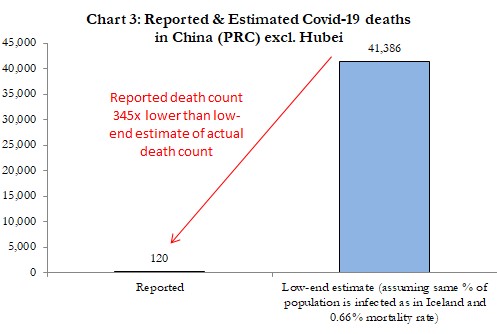
  • Death counts are likely hugely understated as well. Assuming a 0.66%(3) mortality rate against the low-end estimate of 6 million cases, there would have been about 41,000 deaths in China excl Hubei, compared to just 120 deaths reported (Chart 3).

reported vs estimated deaths

  • While every country is struggling to find out the true number of coronavirus cases within their territory, death counts are generally reliable. At very least, they are not understated by a factor of 345x!

Notes:

  1. https://www.statista.com/statistics/1090007/china-confirmed-and-suspected-wuhan-coronavirus-cases-region/
  2. https://www.covid.is/data
  3. The 0.66% mortality rate is based on Chinese data. https://www.bmj.com/content/369/bmj.m1327
Some questions about Chinese Covid-19 data

We urgently need random testing to inform the Coronavirus response

  • Government policy response to Covid-19 is severely hindered by the lack of real-time data on what % of the population has the virus already.
  • The data available to policymakers currently is clearly insufficient. Daily coronavirus death counts get the most media attention, but this is a highly delayed indicator, as there is an estimated 2 – 8 week lag between contracting the infection and death.
  • The media also tracks the number of people who have tested positive for coronavirus. This figure is entirely useless, as most countries now only test patients with severe symptoms, so this potentially underestimates the true number of coronavirus cases in the population by several orders of magnitude.
  • It was eye-opening to read an interview with Prof Neil Ferguson (author of the influential Imperial College study that partly led to implementing the lockdown). He guesstimates that 3-5% of the UK population might have the virus currently, rising to “no more than 10%” in a week’s time.
  • Why are we guesstimating these figures? This is literally the most important data point in informing government response to the virus.

Why we need an up to date measure of how many people have the virus currently

  • To understand how effective the lockdown is in slowing down transmission
    • We would find out when the lockdown gets us over the peak. People are waiting for a fall in the daily death count, but this will only starts weeks after the actual peak. Keep in mind that each week under lockdown causes untold economic damage and hundreds of thousands of job losses.
    • We would find out if the current “weak points” in the lockdown render the whole thing pointless – people can still get infected in crowded supermarkets or on public transport. The inexcusable lack of protective equipment in the healthcare system exposes the 500,000 frontline NHS staff to the risk of infection.
    • We would find out if lifting certain elements of the lockdown (e.g. re-opening more shops or construction sites) increases transmission. If the increase was large, we could quickly tighten the lockdown again.
  • To prepare for near-term demand on hospitals
    • People who require hospitalisation for Covid-19 typically get worse one week after contracting the virus. Having a real-time, region-by-region picture of active infections would give some advance warning to hospitals to better prepare for patient inflow.
  • It would immensely help inform the exit strategy from the lockdown
    • Some think we should try to contain & eradicate the virus by conducting a large number of tests across the population. Others think the virus is too widely spread by now to eradicate it and see eventual herd immunity as the end result.
    • Clearly, both camps are just guessing if we do not know what percentage of the population is already infected. If a significant share of the population has already been infected, then herd immunity is not too far off. If infections are limited to a few percentage points, then eradication seems more viable.
  • To understand how deadly the virus actually is, and how mortality rates break down by age group and other risk factors
    • Experts typically assume that Covid-19’s mortality rate is around 1% and that mortality rates get radically worse for people aged over 50. This is generally based on data out of China. There is no guarantee that the virus works exactly the same way elsewhere, so we need to be able to calculate our own mortality rates to inform our policy response.

How to do random testing

  • It’s fairly simple and requires only limited resources.
  • A random sample of 1,000 people repeated every other day would provide meaningful real time data on the spread of the virus. This would be far more useful than anything we have today.
    • The UK’s is testing 10,000-15,000 people each day (which is pathetic in comparison to other countries) and aims to scale up to 100,000 per day. Random testing would use up only a small share of testing capacity.

Is anyone doing this already?

  • Iceland is the only country in the world that has done random testing.
    • Out of a random sample of 2,300 individuals, 13 (0.6%) have tested positive.
    • It is likely that this percentage could be much larger in other countries. Iceland is not as plugged into global travel (especially at winter time) and its coronavirus response to date has been excellent.
  • Finland and Norway following Iceland’s lead and commissioning random tests. There appears to be some interest from various US states as well.
  • It is baffling why the UK is yet again so far behind the curve.
We urgently need random testing to inform the Coronavirus response

How long until the lockdown is over?

Coronavirus exit strategies

What is the end result we are trying to achieve?

  • We are told we are under lockdown now in order to “flatten the curve”, i.e. reduce the initial spike in hospitalisations so that the healthcare system can cope. But then what happens?
  • The two opposing ends of the post-corona outcomes are the “genie back in the bottle” scenario, where Covid-19 is eliminated from the population completely, and the much-maligned “herd immunity” outcome, where a sufficiently large percentage of the population becomes immune to the virus, either by contracting the virus and recovering from it or through vaccination.
  • I find it incredible that governments across the world have not clearly communicated to their people which outcome they are trying to achieve, given how vastly divergent these strategies are.

“Genie back in the bottle” strategy

  • Most of the Asian nations that are seen by some as successful in containing the crisis (China, South Korea, Taiwan, Hong Kong, Singapore) appear to be going down this route.
    • The strategy is to try to identify each individual who carries the virus by conducting a very high number of tests, and quarantine them and their close contacts.
    • If the government is successful in tracing down every single case, then the virus can be eliminated.
    • There are very valid doubts to be voiced about the data coming out of China and about how successful China is in actually containing the virus, but we’ll leave that aside for now.
  • I humbly suggest that this strategy is unlikely to work.
  • By now, the virus is far too widespread globally to halt the spread.
    • There are over a million identified cases worldwide, but we know that this is actually understating the true number of cases by orders of magnitude. Modelling from Imperial College suggests that a few days ago there were already 1.8 million cases in the UK (2.7% of the population), although only 42,000 (2.3% of all cases) have been identified.
    • The true number of cases globally is realistically over 100 million and increasing.
    • Developing countries have reported relatively few cases so far, but seeing how quickly coronavirus spread all over Europe and North America in just a few weeks, there can be little doubt that the likes of India, Nigeria and Brazil are not far behind.
  • It is not possible to ramp up testing capacity sufficiently across the globe.
    • The UK is struggling to carry out 10,000 tests per day at the moment and industry experts are highly sceptical about plans to ramp up to 100,000 in two months’ time.
    • The international supply chain for testing materials will likely collapse due to every country trying to ramp up capacity simultaneously. There are already ugly accusations of state-sponsored “piracy” to divert medical equipment. Protectionism and export bans will lead to even fewer tests being available globally.
  • Even if one country was able to eradicate infections from its population, it would need to maintain airtight border security and test every single international arrival while the virus circulates elsewhere.
    • In the long term, this leads to economic isolation, increased xenophobia and a sharp drop in international trade. The economic damage from this could be similar to the wave of protectionism during the Great Depression.

“Herd immunity” strategy

  • Herd immunity currently has terrible PR due the UK government’s bungled communication at the onset of the crisis and the resulting media backlash.
    • In popular media, herd immunity is often seen as genocidal and sensationalist articles are published about how it could lead to millions of deaths.
    • However, these narratives ignore that coronavirus is far more widespread in the population already than previously believed and also fail to propose an alternate end result.
  • Herd immunity is the most realistic outcome of the crisis given that it is impossible to eradicate the virus completely at this point. Governments should find a way to re-brand herd immunity (say “mass immunisation”) and explain it better to the public.
  • Experts have floated the idea of relaxing and tightening the lockdown in cycles, to let the population gradually acquire and survive the infection, while maintaining the number of active cases at a level that does not risk overwhelming hospital capacity.
    • Lockdown fatigue is a real risk, and we cannot be certain that the population will comply if they are allowed to socialise one week but not the next.
    • Many businesses cannot easily start and stop work. The economic damage from a drawn out relax/tighten cycle could be just as bad as from an extended lockdown.
  • I find it impossible to understand why the government is not doing randomised testing to establish what % of the population has the virus currently. If 2.7% of the UK population have the virus currently and hospitals will cope in the coming weeks, then herd immunity could be achieved in a matter of months.
    • the 2.7% figure is based on Imperial College’s modelling and has wide confidence intervals (1.2% – 5.4%), so more testing is urgently required to establish accurately what percentage of the population have the virus already.
    • Testing a random sample of 1,000 individuals could be more helpful than any data point we have to date. It is incomprehensible why this has not been performed yet.
  • We need to be clear that people in at-risk groups (which is predominantly older people) need to stay under strict lockdown for months. The data is clear that coronavirus is far more deadly for this group.
    • The public does not properly appreciate that even having sufficient ICU/ventilator capacity will not save people in at-risk groups. To put it bluntly, the medical profession can do very little to save at-risk groups besides telling them to stay quarantined for an extensive period of time. Governments need to communicate this more clearly.
    • The lockdown for at-risk groups could end once the wider population has achieved the critical threshold for herd immunity.
    • Alternatively, development of a vaccine or a cure could also bring normalcy back to at-risk groups.
How long until the lockdown is over?

Warning: central bank coffers at risk

As you would expect from the largest economic collapse in 80 years, the global financial crisis shook many of the basic principles of macroeconomics and left a lot of respected economists looking quite silly. But nothing seems more puzzling than the curious absence of inflation.

When the central banks of the developed world began printing money to soften the blow of the recession, most people were expecting inflation to rise. Some were even warning of hyperinflation. Investors piled into gold, thought to be an inflation-proof investment, and produced a boom and a subsequent bust in the price of gold.

That money printing should cause inflation is very intuitive and is also supported by plenty of historical evidence. With more money chasing the same amount of tangible, real goods, it seems obvious that prices should rise. Throughout history, hyperinflation was a common feature of failing economies, whether it was due to medieval kings resorting to money printing to fund military adventures, Weimar Germany printing to pay war reparations or, more recently, Zimbabwe turning on the printing press to finance the Mugabe regime [1].

But just as you can’t use Newtonian physics to explain the movement of objects as large as planets and stars, it seems that many macroeconomic theories cease to apply to the complex modern world economy. Despite printing money on an unprecedented scale combined with interest rates being lower than ever (also thought to be an inflation-inducing piece of monetary policy), inflation remains extremely low, almost non-existent in all of the world’s major developed economies.

So far, central banks have been relatively conservative in structuring money-printing mainly as a purchase of government bonds. Governments now pay interest to the central banks on the bonds they hold, and given that bonds have maturity dates, there is at least a pretense that the governments will eventually repay to the central banks the money borrowed, reversing the effects of the money-printing. Government accountants have booked the money received from central banks as debt, not as income, meaning that it cannot be used to make government finances look better by reducing the deficit.

But if money-printing doesn’t seem to have any major downsides, why not double down? Why shouldn’t central banks just hand over money to the government, without any expectation of repayment? In Britain for example, £375 billion was printed over the 8 years since the crisis. People tend to skip over numbers when they start to have too many zeroes, but this is an enormous amount. By repeating this, we could increase both the healthcare and education budgets by 20%. Or build 1,500,000 council homes [2].

Intuitively, I feel we should be cautious. A stable, secure currency that is a reliable store of value and a trusted means of exchange is absolutely key to any modern economy. Destroying confidence in the national currency would be disastrous. It also feels difficult to believe that we have found the magic money tree – a license to raise huge amounts of money that doesn’t come from taxpayers and doesn’t need to be repaid.

Monetary policy has been a fringe topic in political life so far. It is far too arcane to make good media headlines. The independence of central banks also been a fundamental tenet of modern market economies, well-respected by mainstream parties. However, with populists of both left-wing and right-wing persuasion on the rise across the world, it is only a matter of time before goverments will try to dip into the central banks’ treasure chests [3]. When politicians smell money, they will try to get their hands on it.

Central bankers need to manage this risk. They might be inclined to believe that their mandate compels them to act as technocrats, operating indepedently of the pressures of politics and public opinion. This would be foolish. Central banks have no manpower. They do not control the police or the military. If they cannot come up with a compelling reason why money-printing is not a valid source of income to the government, politicians hungry for power and oblivious to long-term risks will raid their coffers to the tune of hundreds of billions or even trillions of dollars.


1. “The African state printed trillions of Zimbabwe dollars in February 2006 in order to buy foreign currencies and pay off the country’s loans to the IMF. The central bank repeated the trick three months later, this time in order to finance massive increases in wages of soldiers, policemen and civil servants. Inflation went through the roof, despite Mugabe’s decision to declare it “illegal”.”

http://www.telegraph.co.uk/finance/economics/8135039/Inflation-History-shows-weve-got-it-easy.html

2. In the US, the Fed bought about $2.5 trillion of government debt over 8 years. That’s the equivalent of a 25% increase in federal health & education spending (or 1.5x Iraq wars).

3. A Jeremy Corbyn government is pretty scary in its own right, but with an independent central bank, his spending ambitions would be limited to whatever he can raise in taxes + borrow from investors. But give him control of Bank of England and he can raise unemployment benefits to £1m per week per person.

For readers unfamiliar with British politics, take Bernie Sanders and assume every Republican scare story is 100% true. That’s Corbyn.

Warning: central bank coffers at risk

A game of chicken in Greece (or just self-harm?)

With the negotiations with Greece breaking down and re-starting on a daily basis, with deadlines being missed and new deadlines being set, no one really has an idea if Greece will end up leaving the eurozone, including the people at the table. I don’t particularly want to speculate on the odds, but there are a few points that are worth establishing on the situation:

– Greece, even after 6 years of recession, is still a wealthy country by any measure. 

Greece’s GDP per capita (PPP) at ~$25,000 still puts the country firmly in the rich bracket – China is at $11,000 for example. The minimum wage in Greece is €683 per month (before Syriza’s proposed hike to €750), which is at least twice as much as in any of the Eastern European EU member states that joined in 2004 (except Slovenia). When people make statements that “Greece has nothing left to lose” these numbers are worth keeping in mind.

– Crashing out of the eurozone would be disastrous for the Greeks.

Grexit is generally assumed to involve the government defaulting on a payment to the Troika, which then prompts a bank run leading to the Greek banks quite literally running out of euros, which then culminates in bank deposits being frozen and the country introducing a new national currency. People’s life savings would be lost [1] (except for the hard cash stowed away under matresses) and salaries would be converted into drachmas at unfavorable exchange rates. The price of imported goods (ranging from oil to pharmaceuticals but also things like condoms [2]) would skyrocket provided they remained available on the shelves at all. Keeping in mind that some 70% of Greeks do not want to leave the eurozone in the first place, there is a very real chance that their anger would wash away not only the Syriza government but also democratic society.

– Looking at the numbers, Greece’s debt is not obviously unsustainable.

Greece’s debt to GDP stands at 170% which is a lot. But 80% of the debt is owed to the Troika and it is long-dated with very low interest rates, so debt servicing costs just 4% of GDP, which is less than the interest burden in Ireland, Portugal and Italy and is roughly on par with the US. The Troika have agreed to extending the loans for basically forever as long as Greece puts its government budget in order, so while a lot of people (including the finance minister Varoufakis) have said that a Greek default is inevitable, this really does not seem to be the case.

– Grexit is unlikely to trigger contagion.

Part of the reason why the EU was willing to bail out Greece in 2012 was that there were fears of contagion: i.e. that Greece would be just the first domino to fall and a Greek default would be quickly followed by Portugal, Spain and maybe even Italy. People were also wondering if the French and German banks that have had exposures to Greece would require bailouts themselves.

The world is very different today, which is best illustrated with this chart. The borrowing costs of the eurone periphery have remained remarkably stable despite Greek government bond yields going through the roof. Portugal, widely seen as the second-most vulnerable eurozone member, borrows money for 10 years paying record low interest rates of around 3%.

If there is ever a good time from the EU’s perspective for the showdown with Greece, that is probably today. I don’t think the EU decisionmakers generally want Greece to leave, but I also feel that there is a lot of frustration building up over Greece’s brinkmanship and plenty of hurt feelings in Germany about waterboarding metaphors and mentions of Nazis and war reparations. [3]

There was a lot of talk about game theory as apparently Varoufakis is an expert game theorist and people seem to consider this a game of chicken with the Troika and the Greek government racing towards the brick wall and seeing who blinks first. But these 4 points above tell me that the balance of power is squarely with the EU. This is not so much a game of chicken… more like Greece banging its own head against the wall.


1. Why anyone would be willing to keep deposits with a Greek bank at this stage is beyond me but there still is €145bn in bank deposits in Greece. I recognize that there is some romantic appeal to the notion of erasing all bank accounts and starting anew in marxist circles but you can be assured that the Greek fat cats have moved their millions to safety a long time ago and the failure of the banks would put the burden mainly on ordinary people. The €145bn works out to about €13,000 per citizen.

2. There is this story of a pack of condoms in Venezula selling for $755 amid massive shortages of basic goods including chicken, sugar and medicines. Everyone seems to assume that this can only happen in Latin America, but Greece does have a shot at becoming Venezuela-on-the-Mediterranean (without the oil).

3. See this surreal interview with Varoufakis in the Spiegel. It is not even really an interview. The Spiegel is feeling butthurt over Greece’s ungratefulness for their rescue package and just goes after Varoufakis for his questionable choice of words.


A game of chicken in Greece (or just self-harm?)